

The enduring mysteries of Fantastic Four #1 (and their possible answers) - jonesmuld1977
The imperishable mysteries of Fancy Four #1 (and their viable answers)
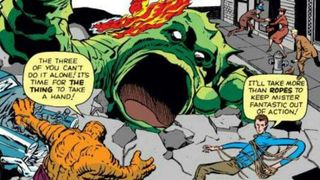
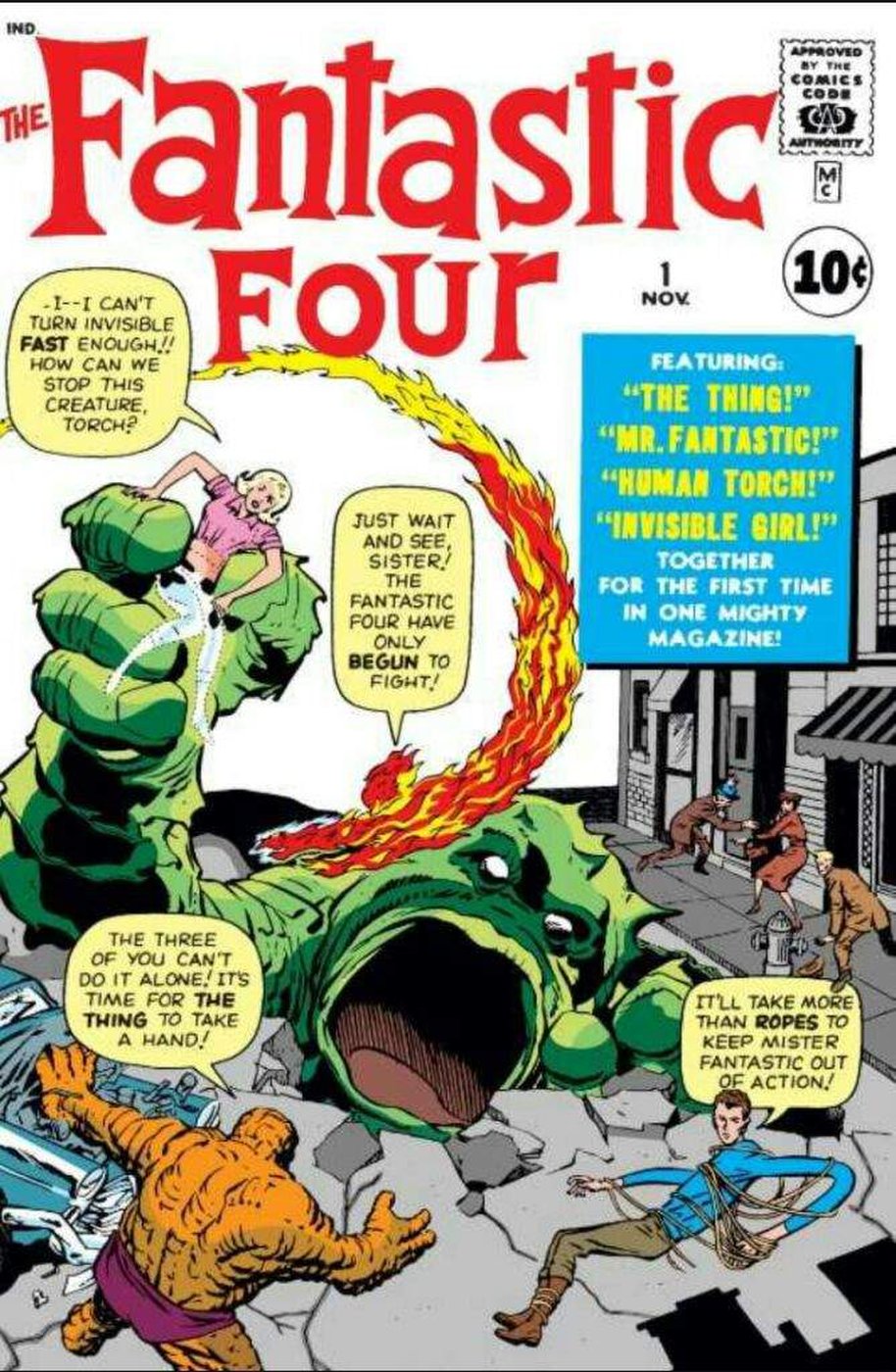
It's the big bang of the Marvel Universe.
Fantastic Four #1 was released happening Lordly 8, 1961, the product of writer Stan Lee and artist Jack Kirby. And since that date, it's been one of the most important and one of the nigh intensely analyzed comic books ever. This year, Marvel has even commissioned o'er 20 artists to re-suck in the intact issue, pageboy-aside-page and panel-by-panel in a comics version of a underwrite song known as Fantastic Four Day of remembrance Protection #1.
Yet still, mysteries hold out.
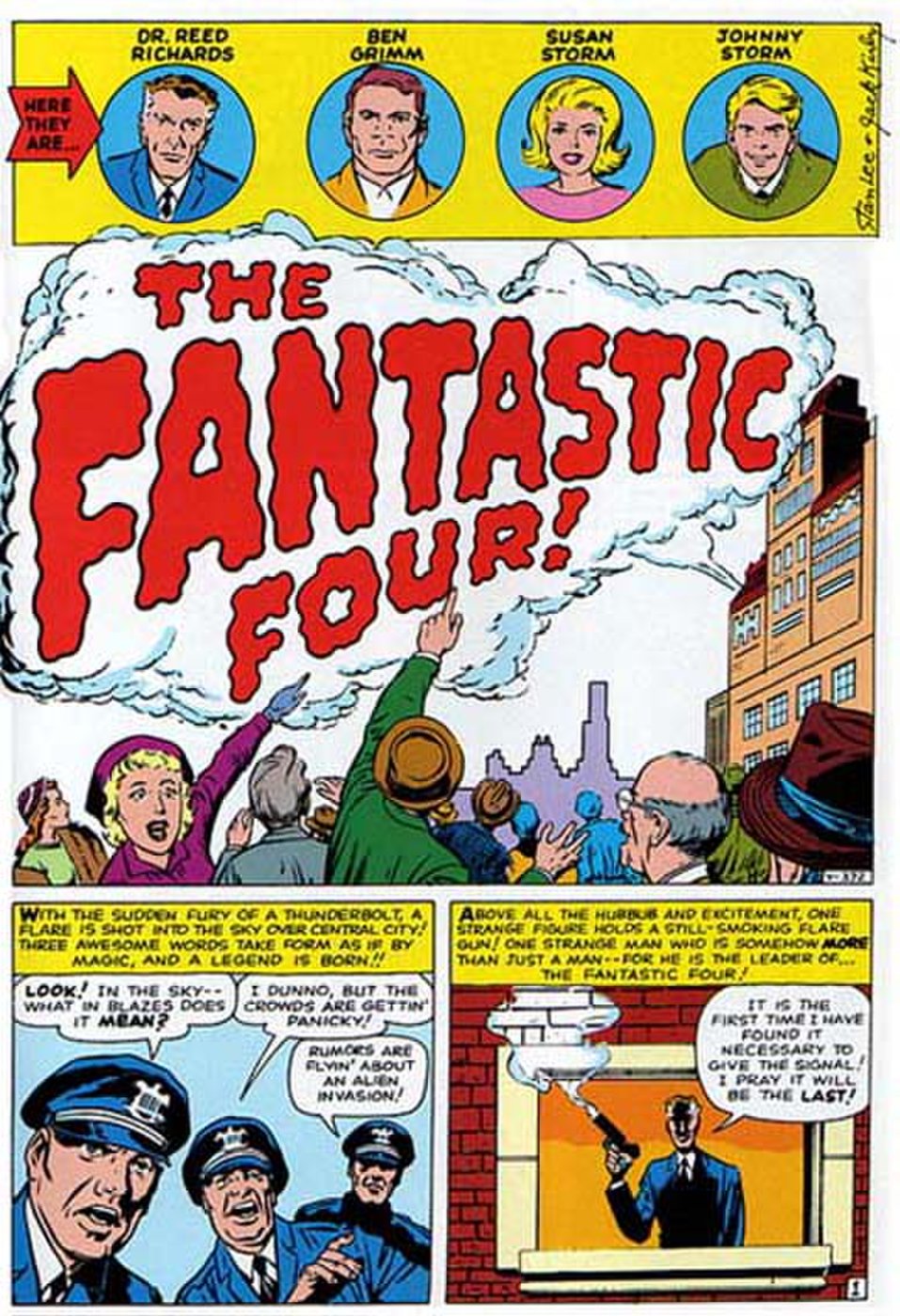
"IT's a significant piece of work, and the first-class honours degree construction auction block of everything that Marvel has become," says Marvel senior vice-president and administrator editor Tom Brevoort. "And part of what makes this book soh absorbing is that there are still things about information technology that no one genuinely knows for sure."
As luck would have it, people including ourselves make been investigating those mysteries. Brevoort has done some sleuthing of his own. Superfans have chimed in. Not all the brunet corners have been illuminated yet, but we can certainly start out to moult some light along some of the abiding mysteries of Fantastic Four #1. Such Eastern Samoa…
WHO inked Marvelous Four #1?
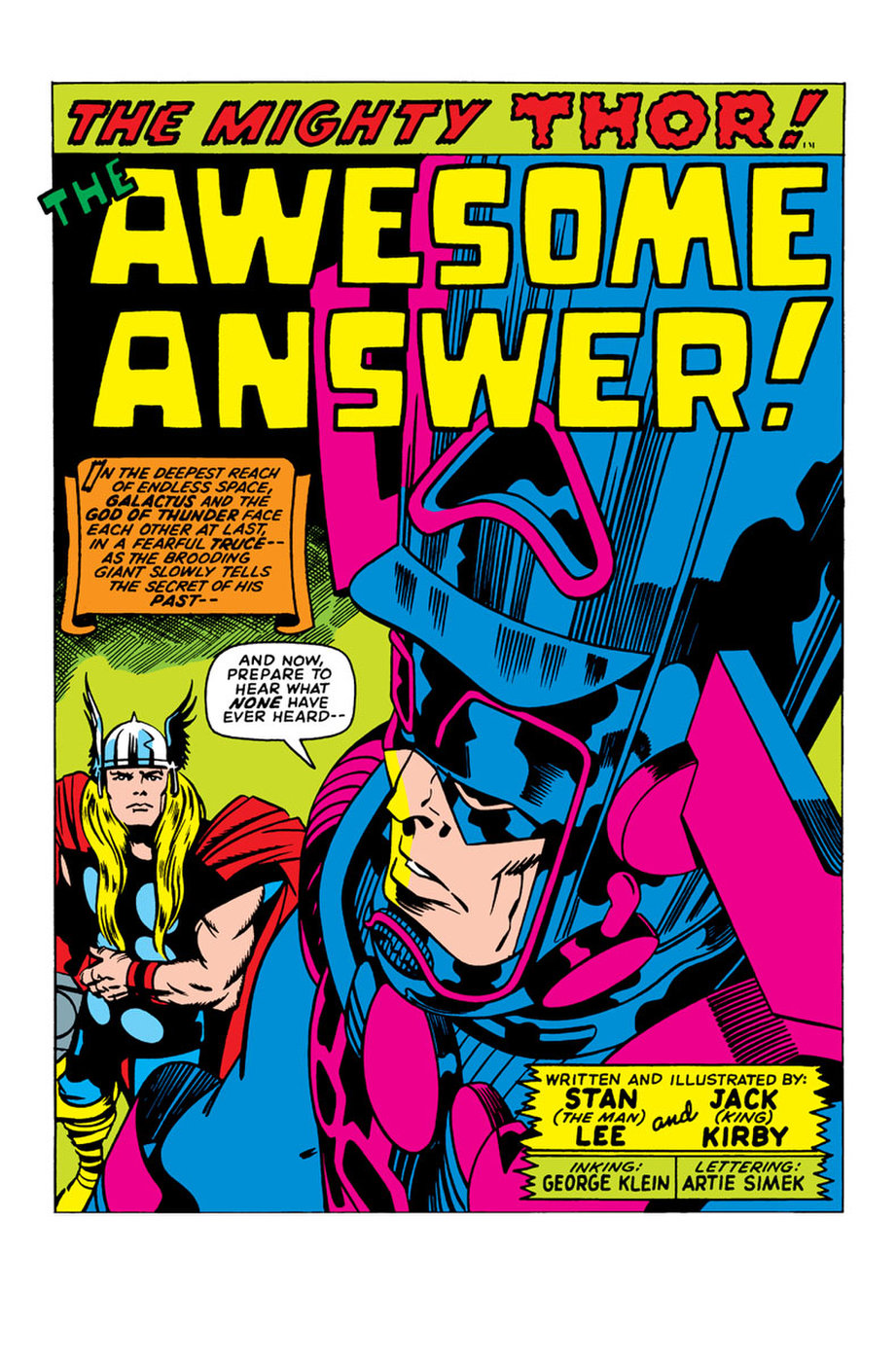
Short resolution: George Klein.
Longer serve: George Melanie Klein, but information technology took 50-plus years to compute that out.
For decades, Marvel ran no inker quotation on Fantastic Four #1 in its many another reprints such arsenic Wonder Masterworks. But in the early '10s, Masterworks editor program Cory Sedlmeier finally made it official: Klein is the inker of both Fantastic Four #1 and #2.
Sedlmeier researched the issue and looked at evidence presented by a number of art experts. Primary feather among these experts is Dr. Michael Vassallo, WHO runs the Timely-Atlas-Comics blog and is broadly considered the foremost expert in Atlas and early Wonder Comics graphics. Vassallo spent years poring o'er thousands of pages of artistic creation samples, analyzing different inkers over penciler Jack Kirby.
For his part, Sedlmeier is certain this mystery is set up to rest.
"Michael Vassallo has giant binders sperm-filled of individual artists' process," Sedlmeier says. "He walked Maine direct a variety of the Klein inking 'tells' with some aspects of his style that are apparent in Grand Foursome #1 showing finished in Klein's work all the way backmost to '40s work like Urania."
The method acting by which Marvel 'awards' a retroactive credit is interesting in itself.
"The process, so much as it is, is that when bear witness comes up, the knowledgeable people here - Jeff Youngquist, Cory Sedlmeier, Maine, whoever else may know - discourse information technology and we weigh IT and date how true it is," Tomcat Brevoort says. "It really comes down to best think and weighing the evidence we undergo."
'I was there' evidence is given particular weight. Even though the original books carried no inker credits until Fantastic Four #9, Marvel has noted Sol Brodsky as the inker on #3 and #4, Joe Sinnott on #5, and Dick Ayers on #6 done #8 for decades.
"Typically when a guy shows up and says, 'I did that,' we tend to buy into that, absent powerful evidence to the contrary," Brevoort says. "In most instances, populate were still aware at the time to confirm that they did it. Sol Brodsky confirmed that he inked issues #3 and #4 back in the '60s. Joe Sinnott inked #5, and a little piece of #6. #6 is credited to Dick Ayers, because Dick did most of IT. Joe started on it and inked a couple of figures before He turned it hind in because helium had some other, more pressing lin. You can see those figures in the book."
Dick Ayers is a Polesta in matters such atomic number 3 this. He unbroken complete, punctilious logs of all the work he did for decades.
"Dick Ayers issues are super-easy to figure tabu," Brevoort says.
But the rest is detective work. Remember, this was 1961. Comics were largely a churn-'mutton-out, on-to-the-next-one business. Fewer people felt they were important. Until Stan Lee. Lee treated his comic books with respect, and started listing credits including inkers and straight letterers with Fantastic Four #9.
"That was improbably important," the late Stan Lee told Newsarama antecedently. "I was trying to make the stories seem as if they had greater condition. You go to a motion picture, and you don't just determine the name of the star. There's also the managing director, the producer, all the co-stars, the light guy, and so forth. So I thought, 'Let's make our stories look Sir Thomas More important; let's feed as many credits as we can.'"
Was Fantastic Four #1 written in reverse?
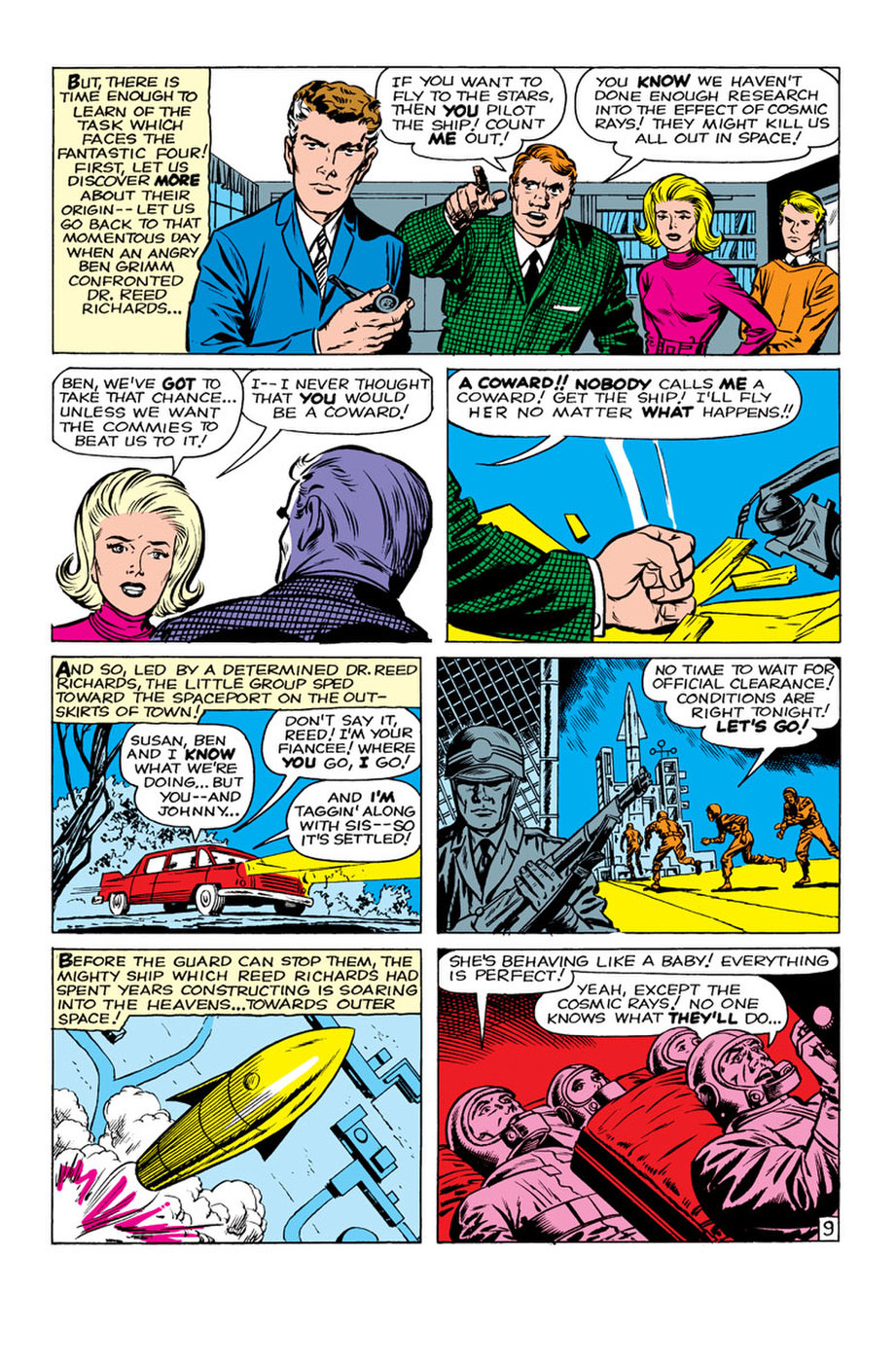
We've all say it: Four mysterious figures with marvellous powers seem, and we're relinquished their backstory of cosmic rays imbuing them with those powers. Then, a monolithic combat with the Mole Man and his giant hugger-mugger monsters ensues.
Merely what if the Mole Man farce was written first?
"We accept the experience as page one is low, and you fling happening from there. It's hard-fought to disassociate yourself from that feel," says Tom Brevoort. "I've heard the arguments for information technology, and there's a really compelling case to equal made that maybe everything from that Mole Man swas to the back of the Koran was designed as a thing that would have ran in i of the monster books, maybe atomic number 3 a pilot for the series, maybe as a one-off. And so when they decided to make it its own Word, they added the origin at the front."
It seems impressive to reckon of Fantastic Iv #1 in that way today because, fit…it has the weight of being Fantastic Four #1. But think in 1961 price: Risible books were a slapdash business, and publishers and creators were tossing anything they could out there to look what would stick. Commemorate, Wanderer-Man's first appearance in Amazing Fantasy #15 was a specified 11 pages long. Thor's debut in Journey into Mystery #83 was 13 pages. Anything's possible.
Brevoort admits it's all conjecture, but he's tantalized by the possibility.
"Why are in that respect chapter titles without chapter numbers game? Wherefore fare they reveal the Thing, and then wad him up to reveal him once more? Even when the Torch first flames happening in the back half, it's dosed like 'This is a thing you haven't seen before as a reader' despite the fact that there's a whole sequence earlier. It really does look to me, with a skilled eye, the like the eldest half of the book and the last half were done independent of each early."

In that location are cardinal massive pieces of evidence that would tend to shoot holes in the back-half-first theory.
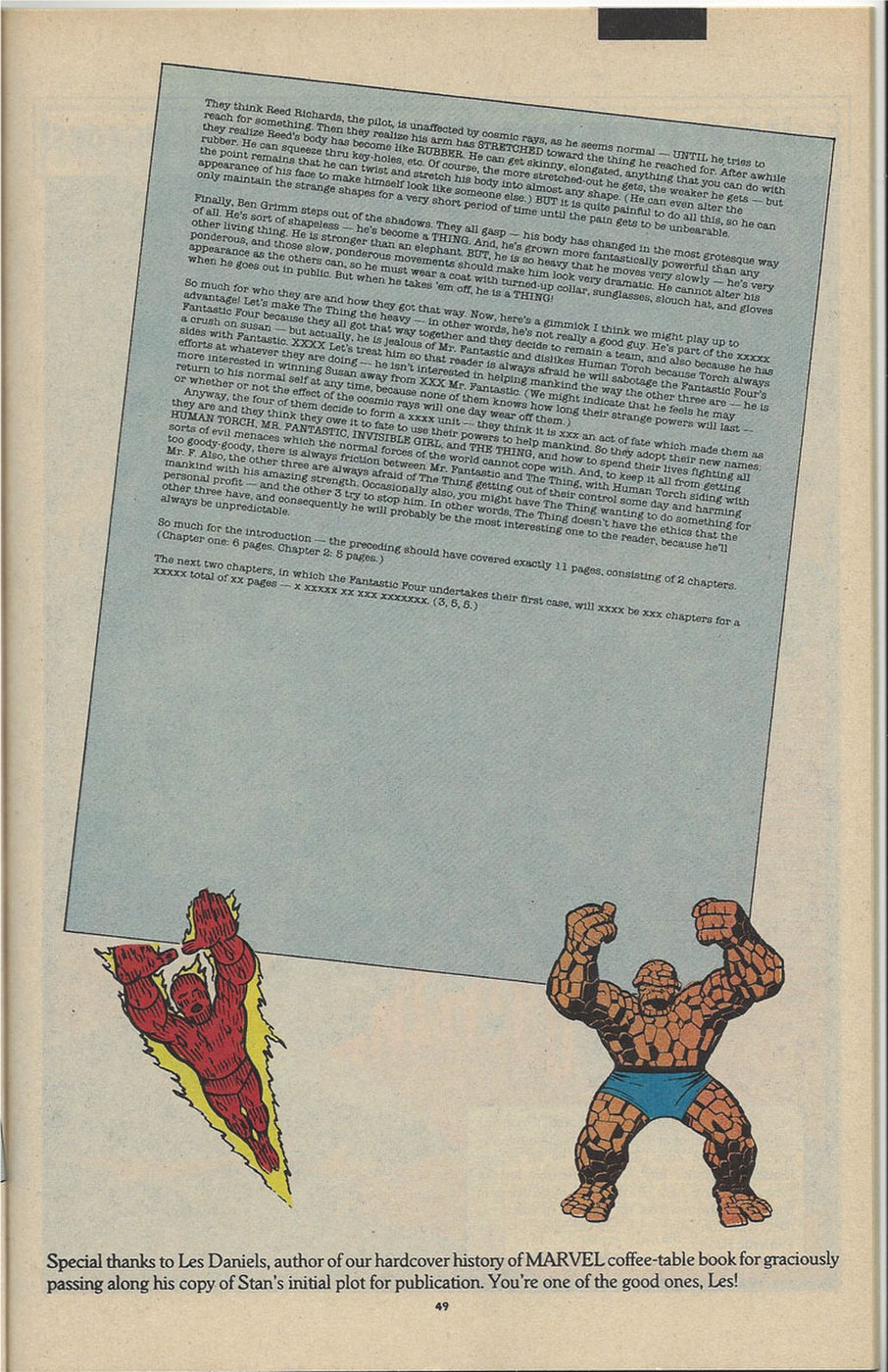
Forward, Wonder printed Stan Lee's originative synopsis for Fantastic Four #1 in the thirtieth anniversary Fantastic Four #358. The synopsis clearly lays out the issue front to back. The page counts do non number - Stan called for a intro of 11 pages, and the intro and origin succession ran 13 pages. But over again, slapdash business.
Roy Lowell Jackson Thomas was an early comic book historian, and became Marvel's second editor-in-honcho after Stan Spike Lee departed the position. He joined the House of Ideas in July, 1965, and he saw Stan's Grotesque Four #1 synopsis.
"I was interested in comics history, and Stan was probably surprised that I cared," Norman Mattoon Thomas says today. "He brought it in one Clarence Shepard Day Jr., and said he'd go crosswise information technology at habitation. I didn't know information technology existed at that point. I had seen his plot for Fantastic Four #8 by that fourth dimension, a pair age in the first place. It's hard to enounce when I proverb [the Fantastic Four #1 game]. Late '65 at the earliest, early '66? Somewhere in thither."
Thomas cannot speak to the specific capacity of the plot, but he certainly had something in his manpower.
"I took a look at it, and gave it backrest to him ulterior that solar day," Thomas says. "We didn't throw a Photostat machine at that time, sol I didn't get a chance to make a copy. I don't have a specific memory board of what was on it, but I do think it was the diagram to the first-year half of Fantastic Iv #1. There's no reason to believe it's not the same affair Marvel ran in that FF day of remembrance progeny, but I couldn't swear to it."
The second massive piece of evidence? Stan Lee side himself.
The narration is unreal by now: Stan was at odds with his publisher, Martin Goodman. Goodman wanted thin stories with basic plots and not a great deal on word picture. Stan was shopworn of cranking out simple fare, and was ready to stop. Stan's married woman, Joan, recommended that if Stan was ready to drop out, he might as well do a record book the way he wanted to. The worst that could happen was that he'd get ahead fired, and he was looking to leave anyway. Stan wrote Fantastic Four #1 the way he wanted to, with depth, humanness, and characters who were wildly three-magnitude. And he wrote from page one along.
"I did the issue in the regularize you read it," he told Newsarama in 2017. "I thought of the characters, and after I had them, I figured they had to fight mortal, then I came up with Groin Man."
Was Fantastic Four #1 snuck in under the distributor's nose?
Before Marvel Comics was Marvel Comics, information technology was Atlas Comics. In 1957, information technology was cranking out 70+ titles (all subordinate the editorship of Stan Tsung Dao Lee!), some monthly, some bimonthly, and a fewer one-shots. Then, topsy-turvydom hit.
Atlas was also a distribution companionship, and distributed its own comic books. But a change in business plan led to a new electrical distributor, North American nation News Ship's company, which quickly went exterior of business Captain Hicks months afterward Atlas signed on. Publisher Dean Martin Goodman had to beat to get a new allocator, Independent News Company, which was coincidently... closely-held by National Periodical Publications, the parent of District of Columbia Comics.
Independent News Company was volitional to remove on Atlas' business, but they weren't too crazy well-nig allowing a robust challenger to D.C.. So the 70-ish title cargo went away, A they limited Telamon to eight books a calendar month. Lee and Goodman chose to use that apportionment to publish 16 bimonthlies. Then, from 1957 on, Atlas was limited in how many books it could produce for dispersion. Until Fantastic Four #1. Although the exact shipping history of Atlas titles circa 1961 is a tad incomplete (more on that in a future article!), many a sources including Steve Duin and Mike Richardson's excellent Comics Between the Panels name to Fantastic Four #1 as a seventeenth title. Tom Brevoort agrees.
"I think information technology was definitely Goodman trying to push through as very much like he possibly could," Brevoort says. "He basically patterned they weren't going to pay attention."
Superheroes had just started to click again with the revival of the Flash at DC. And Goodman likely desirable in.
"Goodman's ism was 'Find outgoing what's popular, produce a shit-long ton of it for a historic period of clock time, rake in the wampum, and get out of Dodge ahead everything crashes,'" Brevoort says. "Martin was a hustler, and hustlers confidence game. I'm beautiful sure he would try to stoolpigeon one more out, make one a time unit, see if they noticed, push the envelope a tiny foster. I'm pretty sure a lot of that just became casebook operative procedure for him."
Again, the precise publishing regularity and history of Atlas at the time was a little erratic. For his part, Stan Lee was just nerve-wracking to make all the trains run punctual.
"I wasn't aware of A-one Four being a 16th issue, a seventeenth issue, or anything," Lee told Newsarama previously. "I was retributory doing the books!"
But there's a very solid take a chance that the bedrock of the Wonder Existence was an end-run around Marvel's distributor of the day.
Where is the seminal art for Fantastic Four#1?
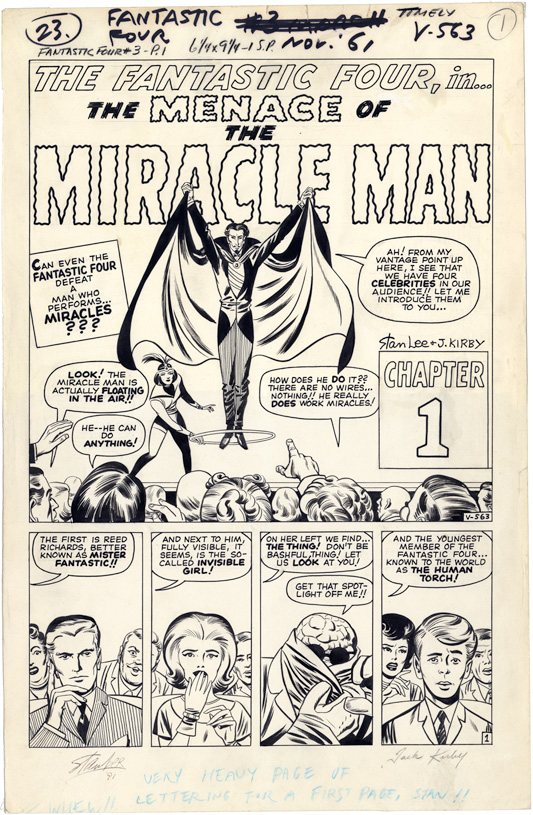
Queerly, extraordinary of the mysteries of Phenomenal 4 #1 could be solved if we could analyse the original art. Pages from #3 are known to exist, but pages from #1 and #2 have ne'er surfaced, contempt vague rumors that some may exist in 'intense collections.'
"Assuming that the Fantastic Quadruplet #1 artistic production hasn't been helpless or destroyed over the years, which it may OK have been, there's a lot you could learn if it ever became public," says Tom Brevoort.
Artists typically wrote the title of the book they were working along at the top of the Thomas Nelson Page. "Fan. Four" might support certain an issue of Fantastic Four, and "Travel" for an issue of Journey into Mystery. If the Fantastic Four #1 pages aforementioned "Amaz. Adv." operating theater "Suspense" at the top, that would be a strong meter reading that the theory that first Fantastic 4 story was indeed intended for another book and perhaps written in reverse is slump.
Brevoort points to discoveries made when Amazing Fantasy #15, the unveiling of Wanderer-Man, surfaced and was donated to the Smithsonian Institute.
"You commode study it and happen upon things like, 'Oh, at that place was originally a different Spider-Man logo here, and look, in this panel, [artist Steve] Ditko had originally penciled another figure in in that location and took it out in the inks,'" he says. "In that respect are all kinds of things you can't bon without this stuff surfacing."
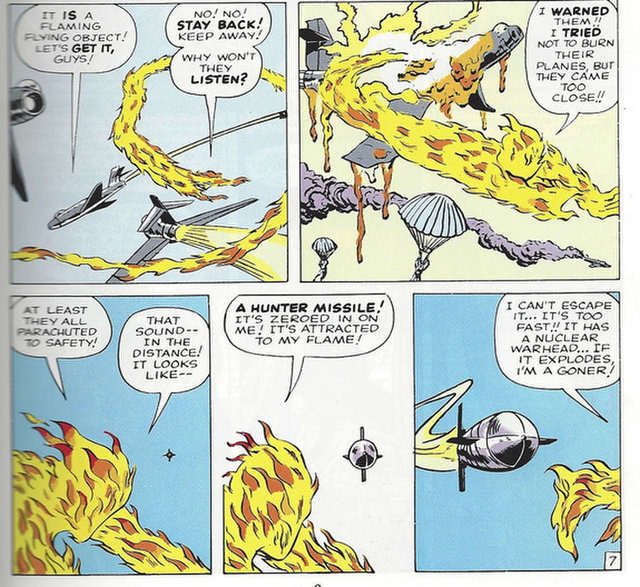
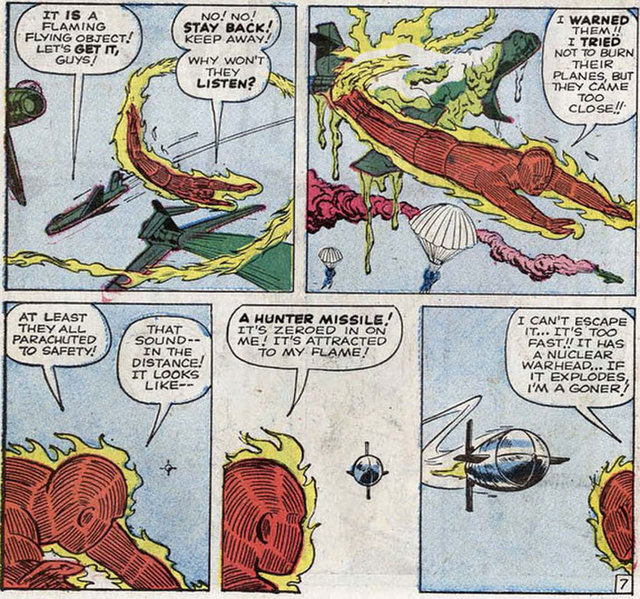
Another tiny mystery: Wonder reprinted the extraction sequence of First-rate Four #1 (1961) for the first fourth dimension in Fantastic Four Annual #1 (1963). In the interim, the Human Torch had gone from a blob of fuel to a Sir Thomas More 'human being' torch, so those pages were updated to show the torch in that more human form. We know that Sol Brodsky re-drew those Torch figures, and a theory exists that he whitethorn sustain done it right on the germinal Fantastic Four #1 boards. If then, we'd lie with that the artwork existed at least until 1963. Simply even Marvel's go-to reproduction bozo doesn't bed surely.
Michael Kelleher is Marvel's official diversion artist for Marvel Masterworks and other vintage collected editions. Kelleher calls himself a "human scanner," sometimes doing digital pixel-by-pel touch-ups on old, damaged artwork scans and sometimes re-drawing images, painstakingly mimicking Jack Kirby, Steve Ditko, or Don River Heck, and the line weights of multiple inkers.
"That could be true," Kelleher says. "Merely it's just Eastern Samoa likely, and we see this rather a trifle, that masses draw o'er copies of the original artwork or the original film. That eccentric of thing, I've actually seen."
Kelleher says he's never seen a page of original art from Fantastic Four #1. But mysteries remain, even in the copies.
"I remember in the scans of the cover I got for Fantastic Quatern #1 - I can't recall if it was film OR a run off - there were characters missing in the desktop, and we had to go back off in and digitally rhenium-insert them," he says.
Film OR stats held more esteem to publishers backwards in the '60s. You could do reprints from them, and erstwhile made, the originals were just an intermediary part of the production process.
"We thought so diminutive of it that believe information technology or not, sometimes we'd give a page to a kid WHO came busy deliver lunch from the chemist's shop," Lee Yuen Kam said in 2017. "As an alternative of giving him money as a tip, we'd say, 'Here you go, josh, cause a page of graphics.' Now I'm certainly not sure that happened with pages of Rattling Little Jo #1 in specific, but we didn't realize these pages had any value at that time."
Roy Thomas is up in the line as to if Brodsky did the Wild Four Annual #1 changes on the master art or on another medium.
"They had some original art approximately then," Thomas says. "The only other thing they would make had were these stat rolls, these old total darkness-and-white Photostats rolled up like scrolls from the Alexandria Library! Very much of those were in a Little Office, just shoved back in a corner against a surround."
Merely was the Marvellous Four #1 original art still in that respect in 1963?
"Sol was a good plenty creative person, atomic number 2 would have just whited out what was there and turned it into something that reflected the change," Saint Thomas says. "But there's zero way to really tell, that I know of, if it was done on the original fine art surgery the Photostats."
Bottom line: No indefinite knows where the archetype pages of Fantastic Four #1 (or #2) are. But if they are of all time saved, some mysteries power cease to be mysterious.
"If those boards exist and come out, you'll have a much better chance of putting things together," Brevoort says. "What's the rubric of the book that's written at the top of all those pages? Are those pages carved apart, cut up, and Re-jiggered as they often were in those years? What kinda artwork department of corrections and stuff like that were done? Seeing the original pages…that's a Rosetta Stone."
Brevoort is non the only one who wants to find the key.
"I wish I could figure all this stuff out!" Roy Thomas says. "Each one of these questions is like a bit Consecrated Grail! I wish I was remunerative many care back in 1965."
If you've made it this far, you're definitely a lover of the Fantastic Four. Then if that's true, induce sure you've read the best Fantastic Cardinal stories of wholly prison term.

Source: https://www.gamesradar.com/fantastic-four-1-mysteries-stan-lee-jack-kirby/
Posted by: jonesmuld1977.blogspot.com
0 Response to "The enduring mysteries of Fantastic Four #1 (and their possible answers) - jonesmuld1977"
Post a Comment